
Best Way to Learn Spanish for Toddlers: Fun and Easy Language Activities
A Joyful Start to Language Learning
Have you ever noticed how easily toddlers pick up songs or phrases from their favorite shows? That same natural ability makes early childhood the perfect time to introduce a second language. Between ages one and four, children’s brains are like sponges — open, curious, and ready to absorb sounds, rhythms, and meaning.
At Semillas Preschool, we believe language learning is not about memorization but immersion in joyful, loving experiences. In our classrooms, Spanish is woven into daily routines, songs, stories, and play. It becomes part of the rhythm of the day — a living, breathing language that children experience, not just study.
Why Start Early?
Starting Spanish early builds a strong foundation for learning and communication. Research shows that bilingual toddlers develop:
- Sharper cognitive and problem-solving skills
- Greater empathy and social awareness
- Stronger memory and listening skills
- A lifelong openness to other cultures
Our curriculum for children ages 6 to 48 months emphasizes that learning happens through exploration, imitation, and pretend play. Language develops alongside social and emotional growth, when children connect, play, and express themselves freely.
At Semillas, we see language as a gift, a way for children to celebrate God’s diverse world and to connect with others through love and understanding.
How to Help Your Toddler Learn Spanish Naturally
The best way to teach Spanish at home is to make it part of your family’s everyday life. Follow these guiding principles, drawn from our Language and Communication and Social-Emotional Development domains:
Play is your toddler’s best classroom.
Use games, songs, and pretend play to connect words to meaning.
Consistency over intensity.
Ten joyful minutes a day matter more than one long session a week.
Follow your child’s curiosity.
If they love animals, start with perro, gato, pájaro.
Use gestures and visuals.
Point, act out, and label objects — children understand long before they speak.
Keep it joyful.
Laughter, movement, and songs make learning natural and lasting.
10 Fun and Easy Spanish Activities for Toddlers
Each activity below builds skills across Semillas’ learning domains — from Language and Communication to Cognitive, Fine Arts, and Physical Development.
1. Action Commands – Movement Anchors Meaning
Say simple commands and act them out together:
“¡Salta!” (Jump!) — “¡Corre!” (Run!) — “¡Aplaude!” (Clap!).
This strengthens listening comprehension, gross motor coordination, and memory, all key skills for ages 18–36 months.
2. Label Walk – Build Vocabulary Through Exploration
Walk around your home or classroom pointing to objects and naming them in Spanish:
“La puerta, la mesa, la flor.”
This activity connects to the Cognitive Domain(exploration and discovery) and the Language Domain (building associations between words and objects).
3. Sing and Move – Language Through Music and Rhythm
Songs like “Cabeza, hombros, rodillas, pies” (Head, Shoulders, Knees, and Toes) engage both mind and body. Music fosters phonological awareness, helps children hear and repeat sounds clearly, and supports fine motor coordination when paired with gestures.
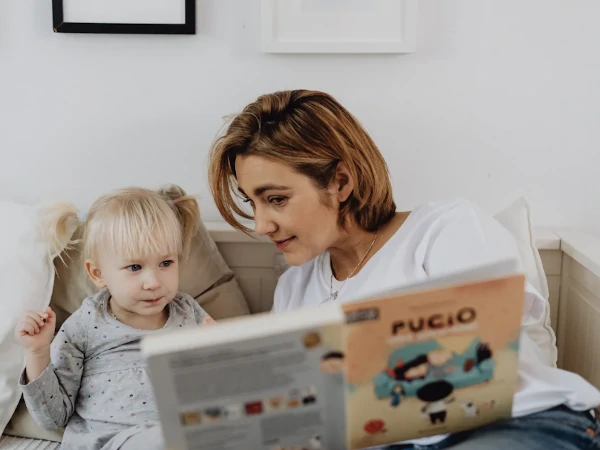
4. Storytime in Spanish – Reading for Connection
Read simple picture books in Spanish or bilingual editions. Pause to point, name, and ask:
“¿Dónde está el gato?” (Where is the cat?)
For toddlers 24–48 months, this builds attention, listening comprehension, and language recall — early literacy milestones in our Reading and Writing domains.
5. Snack Time Spanish – Everyday Conversations
Turn snack time into a language-rich routine:
“¿Quieres más manzana?” (Do you want more apple?)
“Está rico, ¿verdad?” (It’s tasty, isn’t it?)
Using Spanish in daily care moments nurtures self-regulation, social connection, and vocabulary growth — just as emphasized in the Health and Well-Being domain.
6. Pretend Play – Language in Action
During play kitchen time or with dolls, use full Spanish sentences:
“La muñeca tiene hambre.” (The doll is hungry.)
Pretend play supports cognitive development, memory, and social understanding, helping toddlers connect words to emotions and real-life experiences.
7. Color & Shape Hunt – Math Through Language
Invite your child to find objects by color or shape:
Adult: “Veo, veo, ¿qué ves?”
Child: “Una cosita…”
Adult: “¿De qué color es?”
This interactive game connects early math (sorting, colors, shapes) with language comprehension, reinforcing concepts found in the Math and Cognitive domains.
Adult: “Veo, veo, ¿qué ves?”
Child: “Una cosita…”
Adult: “¿De qué color es?”
This interactive game connects early math (sorting, colors, shapes) with language comprehension, reinforcing concepts found in the Math and Cognitive domains.
8. Picture Matching Game – Real-World Connections
Use picture cards and real objects: match la manzana (apple) with a real apple.
Matching reinforces object permanence, memory, and classification, foundational skills for ages 12–36 months.
9. Spanish Scavenger Hunt – Explore and Discover
Create a simple picture list and ask your toddler to find items:
“Encuentra algo que puedes comer.” (Find something you can eat.)
Exploration builds independence, problem-solving, and language comprehension, all key cognitive milestones.
10. Repetition Through Routine – Comfort and Language Growth
Repeat short Spanish phrases during daily transitions:
“¡Buenos días!” (Good morning), “Vamos afuera” (Let’s go outside), “Hora de dormir” (Time for bed).
Routines support emotional security and predictable language exposure, helping children connect language with action and rhythm.

Parents
Remember: toddlers understand far more than they can express. Silent absorption always comes first. One day, you’ll hear your child sing “Los pollitos dicen…” or ask for “¡Más agua!” without prompting.
At Semillas Preschool, we nurture this natural process through full Spanish immersion, faith-based values, and loving relationships. Every word, gesture, and song strengthens not just communication, but connection, between language, culture, and heart.
Together, parents and teachers create a partnership that helps children grow in wisdom, joy, and faith, learning Spanish the same way they learn everything else: through play, curiosity, and love.
References & Further Reading
- Kuhl, P. K. (2017). Bilingual Babies: Study Shows How Exposure to a Foreign Language Ignites Infants’ Learning. University of Washington.
- Krashen, S. (1982). Principles and Practice in Second Language Acquisition.
- ResearchGate (2023). The Effects of TPR on the Second Language Learning of 3–4-Year-Old Children.
- Hoff, E. et al. (2018). Quantity and Quality of Exposure in Early Bilingual Development. National Institutes of Health (PMC6168212).
- Genesee, F. (2016). Early Childhood Bilingualism: Perils and Possibilities. Child Development Perspectives.

