
Easy and Fun Science Experiments for Kids to Try at Home
Simple discoveries that spark curiosity and wonder
Science in early childhood is not about memorizing facts or completing perfect experiments. It is about wonder, observation, and the joy of discovering how the world works. At Semillas Preschool, we believe children are natural scientists. They question, explore, predict, and test ideas every day — whether watching leaves fall, mixing colors, or exploring water in the sensory table.
At home, parents can create beautiful moments of discovery using everyday materials. The science activities below are designed to nurture curiosity, support hands-on exploration, and strengthen early thinking skills. They are simple, safe, meaningful, and deeply aligned with the Semillas curriculum, where play and inquiry guide learning.
1. Rainbow Walking Water
A magical way to explore color mixing and capillary action.
This experiment feels like a rainbow growing before your eyes.
This experiment feels like a rainbow growing before your eyes.

Materials:
- 6 clear cups
- Water
- Paper towels
- Red, yellow, blue food coloring
How to do it:
- Line up the 6 cups. Fill cups 1, 3, and 5 with water.
- Add red to cup 1, yellow to cup 3, blue to cup 5.
- Roll paper towels into strips and place one end in each cup, creating bridges.
- Watch as water “walks” across the towels and mixes colors in the empty cups.
What children learn:
- Color mixing (secondary colors)
- Capillary action (water moving upward)
- Observation and prediction skills
Spanish exploration:
- “Qué colores ves?”
- “Qué crees que pasará después?”
This slow process encourages patience and wonder.
2. Sink or Float Treasure Hunt
A simple but powerful exploration of density
Children love water play, and this experiment introduces scientific thinking through touch, sight, and movement.
Children love water play, and this experiment introduces scientific thinking through touch, sight, and movement.
Materials:
- A bowl or bin of water
- A collection of small household objects (spoon, coin, cork, crayon, leaf, plastic lid)
How to do it:
- Before testing, invite your child to predict which items will sink or float.
- Drop each item into the water and observe.
- Sort objects into “sink” and “float” piles.
What children learn:
- Prediction and hypothesis
- Density and buoyancy
- Classification
Try adding Spanish vocabulary:
- “Hundir” (sink)
- “Flotar” (float)
- “Ligero” (light)
- “Pesado” (heavy)
3. Homemade Volcano
A classic experiment that never loses its excitement
This activity lets children observe a chemical reaction in a dramatic, memorable way.
This activity lets children observe a chemical reaction in a dramatic, memorable way.
Materials:
- Baking soda
- Vinegar
- A cup or small container
- Food coloring (optional)
- Tray or outdoor space
How to do it:
- Place the container on a tray.
- Add a spoonful of baking soda.
- Pour vinegar over it and watch the eruption.
- Add color for extra fun.
What children learn:
- Chemical reactions (acid + base)
- Gas formation (bubbles of carbon dioxide)
- Cause and effect
Spanish phrases to include:
- “Vamos a ver qué sucede.”
- “Fue una reacción!”
Children delight in repeating the eruption, and the repetition deepens learning.
4. Growing a Bean in a Bag
Watching life grow — slowly, gently, beautifully
This experiment invites children to observe plant growth up close, fostering patience, care, and respect for creation.
This experiment invites children to observe plant growth up close, fostering patience, care, and respect for creation.
Materials:
- A zip-top bag
- Paper towel
- A bean seed
- Water
How to do it:
- Wet the paper towel and place it inside the bag.
- Add the bean.
- Seal the bag and tape it to a sunny window.
- Observe growth over the next several days.
What children learn:
- Plant life cycle
- Roots and shoots
- The needs of living things (sun, water, air)
Faith connection:
Invite your child to say a small gratitude prayer as they watch the seed grow:
“Gracias, Señor, por la vida que crece.”
5. Magic Pepper Science
A simple and fascinating introduction to surface tension
Materials:
- Bowl of water
- Black pepper
- Dish soap
- Cotton swab
How to do it:
- Sprinkle pepper across the water surface.
- Dip the cotton swab in dish soap.
- Touch the center of the water.
The pepper quickly moves away!
What children learn:
- Surface tension
- The effect of soap on molecular bonds
- Observation and surprise
Spanish phrases:
- “Mira cómo se mueve!”
- “Qué crees que hizo el jabón?”
6. Shadow Tracing Outdoors
Exploring light, movement, and time
Shadows are a wonderful way for children to experiment with the position of the sun and their own bodies.
Shadows are a wonderful way for children to experiment with the position of the sun and their own bodies.
Materials:
- Chalk
- A sunny outdoor space
How to do it:
- Have your child stand still and trace their shadow.
- Return an hour later to trace it again.
- Compare the two outlines.
What children learn:
- The sun’s movement
- How light creates shadows
- Observation and comparison
Try pairing this with Spanish terms:
- “Sombra” (shadow)
- “Luz” (light)
- “Más largo” (longer)
- “Más corto” (shorter)
7. Ice Excavation Dig
A sensory-rich way to explore melting and temperature
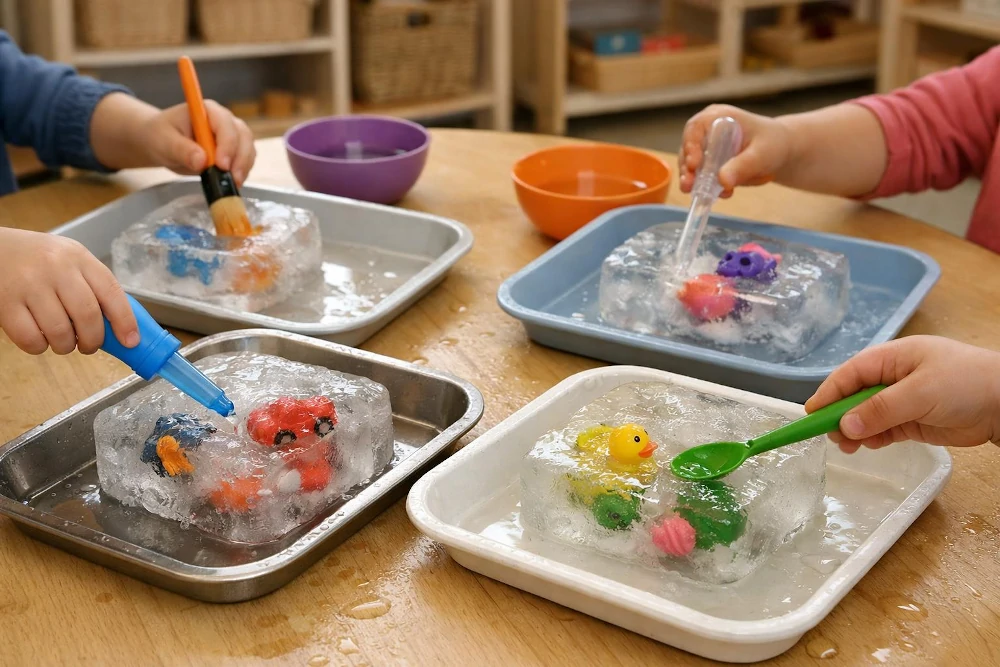
This is both a science experiment and a sensory adventure.
This is both a science experiment and a sensory adventure.
Materials:
- Small toys
- Ice cube tray or container
- Water
- Salt
How to do it:
- Freeze small toys inside ice blocks.
- Provide tools such as spoons, droppers, or paintbrushes with warm water.
- Let children excavate the objects.
What children learn:
- Changing states of matter
- Temperature and melting
- Problem-solving
Add Spanish vocabulary:
- “Frío” (cold)
- “Caliente” (hot)
- “Derretir” (melt)
8. Balloon Rocket
A fun way to explore force and motion
Materials:
- Balloon
- Straw
- String
- Tape
How to do it:
- Thread string through the straw and secure both ends across a room.
- Tape a balloon to the straw.
- Blow up the balloon, hold the end closed, and then release.
What children learn:
- Force and motion
- Cause and effect
- Air pressure
Spanish connection:
- “Vuela!”
- “Qué rápido fue!”
9. Color-Changing Flowers
Exploring how plants drink water
Materials:
- White flowers (like carnations)
- Food coloring
- Water
- Clear jars
How to do it:
- Add water and food coloring to each jar.
- Place a flower in each jar.
- Watch as petals slowly change color over a few days.
What children learn:
- Capillary action in plants
- Observation over time
- How flowers absorb water
This experiment encourages patience, attention, and appreciation for nature’s beauty.
Why Science Experiments Matter in Early Childhood
Science encourages children to:
- Ask questions
- Make predictions
- Observe carefully
- Test ideas
- Adjust their thinking
- Collaborate with others
- Use new vocabulary in both Spanish and English
- Develop confidence through exploration
These skills lay the foundation for STEM thinking, problem-solving, and lifelong curiosity. At Semillas, science is not a separate subject — it is woven into play, nature exploration, sensory experiences, and everyday classroom rituals.
The Semillas Approach to Science
Our curriculum emphasizes:
- Hands-on learning: Children learn through touch, movement, and real experiences.
- Nature as teacher: God’s creation is full of mysteries waiting to be explored.
- Bilingual immersion: Spanish vocabulary is integrated naturally into experiments.
- Process over product: The goal is discovery, not a perfect result.
- Joy and curiosity: We want children to feel excited about learning.
Science becomes a gentle invitation to notice, wonder, and appreciate the world around them.
Final Thoughts: Creating Moments of Wonder
The science experiments above require simple materials but create meaningful learning moments. When children make a volcano erupt, watch a seed sprout, or observe colors walking from cup to cup, they are building a foundation of curiosity, confidence, and awe.
At Semillas, we want families to feel empowered to bring learning home in natural, joyful ways. These experiments are not about producing perfect scientists — they are about nurturing hearts and minds ready to explore God’s world with wonder.
At Semillas, we want families to feel empowered to bring learning home in natural, joyful ways. These experiments are not about producing perfect scientists — they are about nurturing hearts and minds ready to explore God’s world with wonder.

