
Fun and Educational Kindergarten Games for Home and Classroom
Playful learning that strengthens skills, confidence, and connection
Kindergarten is a magical year. Children grow in independence, curiosity, language, and problem-solving, and they begin to form a true sense of themselves as learners. At Semillas, we believe that children learn best when they feel safe, loved, and encouraged to explore. Whether at home or school, games offer an ideal bridge between joyful play and meaningful learning.
Games help children practice academic skills, strengthen social development, build emotional regulation, and learn how to cooperate with others. They also provide wonderful opportunities for Spanish immersion, hands-on exploration, and movement — three pillars of our approach at Semillas.
Below, you’ll find a collection of fun, developmentally rich games perfect for kindergarten-aged children. Each one supports learning in a playful, intentional way and can easily be adapted for home, classroom, or small-group settings.
1. Alphabet Scavenger Hunt
Bringing letters to life through movement and exploration
Children this age benefit from connecting letters with experiences, not memorization. An alphabet scavenger hunt turns letter recognition into a multisensory adventure.
Children this age benefit from connecting letters with experiences, not memorization. An alphabet scavenger hunt turns letter recognition into a multisensory adventure.
How to play:
- Choose a letter of the day.
- Invite children to find objects around the house or classroom that begin with that letter.
- Encourage Spanish vocabulary: “Letra ‘M’… ¿qué podemos encontrar que empiece con /m/?”
Why it works:
This game supports phonological awareness, vocabulary development, and confidence. Children also practice categorizing and observational skills — two important foundations for reading.
2. Number Line Hop
Early math meets joyful movement
Movement is essential in early childhood. When children interact physically with numbers, they strengthen mathematical understanding in a concrete way.
Movement is essential in early childhood. When children interact physically with numbers, they strengthen mathematical understanding in a concrete way.
How to play:
- Create a large number line on the floor using tape or paper.
- Call out numbers and invite children to hop, skip, or tiptoe to the correct spot.
- Add challenges: “Salta al cinco… ahora al número que viene después del dos.”
What children learn:
- Sequencing
- Counting forward and backward
- Number sense
- Body awareness and motor planning
3. Story Builders
Developing language, imagination, and storytelling skills
Oral storytelling is key to kindergarten literacy. Story Builders encourages creativity while strengthening narrative structure.
Oral storytelling is key to kindergarten literacy. Story Builders encourages creativity while strengthening narrative structure.
How to play:
- Place picture cards or familiar objects in a basket.
- Children draw three items and build a story using all of them.
- Use Spanish phrases to enrich language:
- “Había una vez…”
- “¿Qué pasó después?”
- “¿Cómo terminó la historia?”
Why this game matters:
Storytelling builds comprehension, vocabulary, sequencing, and confidence. It also allows teachers to observe expressive language skills in both English and Spanish.
4. Shape Detective
Geometry hidden in everyday life
Kindergarteners love to feel like experts. Becoming a Shape Detective helps children observe the world through patterns and geometry.
How to play:
- Call out a shape (circle, triangle, rectangle).
- Children search the room for objects that match the shape.
- At home, children can take photos or draw what they find.
Learning skills:
- Spatial reasoning
- Geometry vocabulary
- Visual discrimination

5. Word Builders with Blocks or Magnets
Hands-on reading readiness
Instead of memorizing sight words, kindergarteners benefit from manipulating letters to form words.
Instead of memorizing sight words, kindergarteners benefit from manipulating letters to form words.
How to play:
- Provide letter blocks, tiles, sticks, or magnetic letters.
- Say a simple word (“sun,” “map,” “pan”) and let children build it.
- Encourage them to segment sounds: /s/ – /u/ – /n/.
Why it works:
Children learn through touch, movement, and experimentation. This supports decoding skills and phonics readiness in a joyful way.
6. Pattern Train
Building early math thinking through rhythm and sequence
Patterns strengthen logic, prediction, and early algebraic thinking.
Patterns strengthen logic, prediction, and early algebraic thinking.
How to play:
- Provide colored blocks, bottle caps, pom-poms, or any household items.
- Start a simple pattern: red–blue–red–blue.
- Invite children to extend or create their own.
Add Spanish:
- Qué viene después?”
- “Este patrón es AB… ¿podemos hacer un patrón ABC?”
Core skills:
- Logical reasoning
- Sequencing
- Visual memory
7. Kindness Cards
Growing social-emotional skills with simple acts of love
At Semillas, we nurture a culture of compassion and faith. Kindness Cards are a beautiful way to help children understand empathy and gratitude.
At Semillas, we nurture a culture of compassion and faith. Kindness Cards are a beautiful way to help children understand empathy and gratitude.
How to play:
- Provide paper hearts or small cards.
- Ask children to draw or write something kind for a family member, friend, or classmate.
- Incorporate faith by adding phrases like “Te mando amor” or “Gracias por…”
Why this matters:
Kindergarteners learn emotional language, generosity, and community-building. It also helps regulate behavior because children feel valued and connected.
8. Sound Sorting
Developing phonemic awareness through listening games
Listening games are essential for reading readiness.
How to play:
- Place picture cards or objects in a bowl.
- Children sort them by beginning sound.
- You can make it bilingual: “C” for “cama,” “casa,” “cereal.”
Why this works:
Sound awareness is one of the strongest predictors of later reading success. Sorting transforms it into a playful, low-pressure experience.

9. Treasure Hunt Reading Clues
Beginning literacy through adventure
Treasure hunts tap into curiosity and motivation, two powerful learning drivers.
Treasure hunts tap into curiosity and motivation, two powerful learning drivers.
How to play:
- Write simple clues (or draw picture cues) and hide them around the room.
- Each clue leads to the next until the “treasure” is found.
- Use Spanish words or bilingual clues to support immersion.
Early literacy skills:
- Reading simple words
- Comprehension
- Sequencing
- Inference
10. Roll-and-Add Race
Early math fluency disguised as play
This game introduces addition concepts through movement and excitement.
This game introduces addition concepts through movement and excitement.
Materials:
- Two dice
- Paper number line or scoreboard
How to play:
- Child rolls two dice, counts the total, and moves a game marker that many spaces.
- Add Spanish: “Cuánto es tres más dos?”
Skills strengthened:
- Addition
- Counting strategies
- Probability awareness
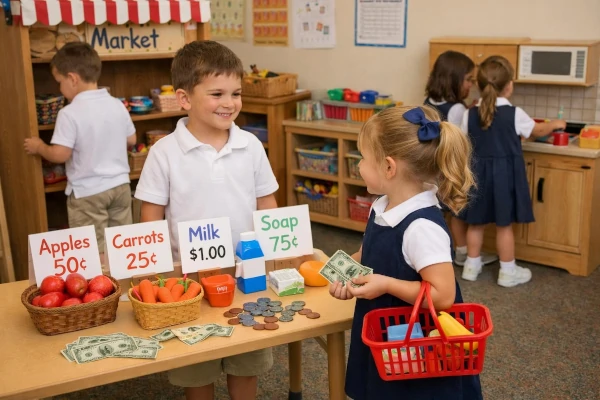
11. Classroom or Home Market
Real-life math meets imagination
Pretend markets give children the chance to role-play using numbers, money concepts, language, and social skills.
Set up:
- Use pretend food or household items
- Make simple price tags
- Provide coins or paper money
How to play:
Children take turns being the shopper and the shopkeeper.
Benefits:
- Math application
- Communication
- Social negotiation
- Early financial literacy
Add Spanish phrases like:
- “Cuánto cuesta?”
- “Aquí tiene su cambio.”

12. Science Sink-or-Float Challenge
Hands-on discovery using water and everyday objects
Science in kindergarten should feel like wonder. Children learn best when exploring with their senses.
Science in kindergarten should feel like wonder. Children learn best when exploring with their senses.
How to play:
- Fill a bin with water.
- Provide various objects (crayon, cork, spoon, leaf, coin).
- Ask children to predict: “Crees que va a flotar o hundirse?”
- Then test and compare results.
Why it’s powerful:
- Encourages prediction and observation
- Teaches scientific reasoning
- Supports vocabulary (“ligero,” “pesado”)
Why Games Matter in Kindergarten
Games are not just fun. They provide children with a safe space to practice skills, persevere through challenges, and collaborate with peers. At Semillas, games are woven into daily routines because they:
- Strengthen academic readiness
- Develop language in both English and Spanish
- Build motor coordination and sensory awareness
- Support emotional resilience and empathy
- Encourage curiosity, responsibility, and independence
- Connect children with their community and their faith
Games turn learning into something joyful and meaningful — not rushed, pressured, or stressful.
Final Thoughts: Learning Through Joy
Kindergarten is not about speeding ahead academically. It is about building strong roots — socially, emotionally, linguistically, spiritually, and cognitively. Games offer children the freedom to explore, the confidence to try new things, and the joy of learning in community.
Whether at home or in the classroom, these games create shared moments of laughter, discovery, and connection. They help children feel capable, loved, and excited about learning — the foundation we cultivate every day at Semillas.
Whether at home or in the classroom, these games create shared moments of laughter, discovery, and connection. They help children feel capable, loved, and excited about learning — the foundation we cultivate every day at Semillas.

